| Quick Facts — Orchid Bees (Euglossini) | |
|---|---|
| Tribe | Euglossini (family Apidae) |
| Known species | ~250 worldwide |
| Major genera | Eulaema, Eufriesea, Euglossa, Exaerete, Aglae |
| Distribution | Exclusively Neotropical (Mexico through South America) |
| Body length | 7–28mm depending on species |
| Notable trait | Males collect fragrant compounds in specialized hind-leg pouches |
| Social behavior | Mostly solitary; some communal nesting |
| Tongue length | Among the longest of any bee — up to body length in some species |
| Ecological role | Exclusive pollinators of many Neotropical orchid species |
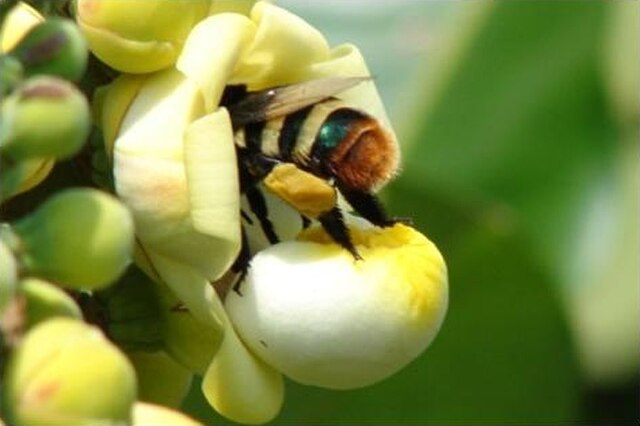
Orchid bee (Eulaema sp.) — Neotropical rainforest. Photo: Alex Popovkin, CC BY 2.0.
The Most Beautiful Bees in the World
Among the 20,000 bee species on Earth, no group produces the sheer visual spectacle of the orchid bees. The males — which are responsible for the group's reputation — are covered in an iridescent metallic exoskeleton that produces colors of extraordinary intensity: emerald green that seems to glow from within, electric blue, burnished gold, deep copper, and rich purple. The colors are structural rather than pigment-based, produced by microscopic layers in the exoskeleton that diffract light like a diffraction grating, producing hues that shift subtly with angle of view.
Female orchid bees are also often metallic but generally less brilliantly colored than males. They spend their lives in the more prosaic work of nest construction and larval provisioning. It is the males — famously purposeless in most bee species — that have evolved the orchid bee's most extraordinary behaviors.
The Fragrance Collectors
Male orchid bees do not collect pollen or nectar for food. Instead, they collect aromatic chemical compounds — terpenoids, esters, ketones, and alcohols — from a diverse range of sources including orchid flowers, rotting wood, fungi, and plant resins. They gather these compounds using specialized absorption pads on their front legs, then transfer them to enlarged, sponge-like structures on their hind tibiae — specialized organs found in no other bee group — where the compounds are stored and blended into a complex personal fragrance bouquet.
The purpose of this fragrance collection is mating display. Male orchid bees gather at traditional display sites — often a particular sunlit patch of forest floor or a specific tree trunk — and release their stored fragrance compounds while hovering in a distinctive buzzing flight. Females assess these displays and select mates based on the complexity and quality of the male's fragrance bouquet. A male that has successfully gathered rare or diverse fragrance compounds demonstrates, in effect, his ability to range widely through the forest and locate rare resources — a proxy for genetic quality and territory quality that females use in mate selection.
Some Neotropical orchid species produce no nectar and no accessible pollen — they offer male orchid bees nothing but fragrant chemical compounds, and rely entirely on the bees visiting multiple flowers to collect the compounds for inadvertent cross-pollination. The orchid has co-evolved a flower that mimics the appearance and scent profile most attractive to specific orchid bee species, in some cases achieving pollination through pure chemical deception without providing any reward at all.
The Orchid Partnership
The relationship between orchid bees and their namesake flowers is one of the most remarkable examples of co-evolution in biology. Many Neotropical orchid species — including numerous genera in the subtribe Stanhopeinae — are pollinated exclusively by one or a small number of orchid bee species. The orchid has shaped the male bee's fragrance-seeking behavior through millions of years of evolutionary pressure, and the bee has shaped the orchid's flower structure and chemistry in return.
Some orchid flowers are structured so that when a male bee enters to collect fragrance compounds, the flower's pollinia (pollen masses) are deposited in a highly specific location on the bee's body — the thorax, abdomen, or head — that exactly corresponds to the position of the stigma in another flower of the same species. The precision of this placement ensures that cross-pollination occurs only between flowers of the same species, even when the bee visits many different orchid species during a foraging bout.
The ecological consequence is profound: the extinction of a single orchid bee species can cause the extinction of the orchid species that depends on it, and vice versa. In fragmented tropical forest landscapes, where orchid bee populations become isolated in habitat patches too small to sustain viable populations, both the bees and their dependent orchids disappear together.
Extraordinary Tongues
Several orchid bee species have evolved extraordinarily long tongues — in some cases as long as or longer than the bee's entire body — to access nectar from deep-tubed tropical flowers. The long-tongued orchid bee Eulaema meriana has a tongue that exceeds its 20mm body length, allowing it to reach nectar in flowers that no other pollinator can access. This extreme tongue length has co-evolved with the deep corolla tubes of the flowers the bee visits, creating partnerships of mutual dependency.
The existence of these long-tongued bees in tropical ecosystems supports plant species that would otherwise have no pollinator — their loss from a habitat therefore removes the reproductive capacity of the plants they serve, with cascading effects through the food web that depends on those plants' fruits and seeds.
Distribution and Habitat
Orchid bees are exclusively Neotropical — found only in the Americas from central Mexico south through the Amazon basin to northern Argentina. They are most diverse in the lowland tropical rainforests of the Amazon and Central America, where the combination of high plant diversity, stable warm temperatures, and intact forest structure supports the full range of fragrance sources and nesting habitats they require.
Some species extend into dry forests, cloud forests, and even degraded secondary habitats, but the most specialized and spectacular species are restricted to intact primary forest. Deforestation and habitat fragmentation across the Neotropics directly threaten orchid bee populations and the orchid species that depend on them.
Monitoring Tropical Forest Health
Orchid bees have proven to be exceptional indicator species for tropical forest health. Because they require intact forest for both fragrance source diversity and nesting habitat, orchid bee species richness in a given area strongly predicts the overall biodiversity and ecological integrity of the surrounding forest. Researchers use orchid bee community surveys — conducted by placing fragrance baits that attract males to standardized traps — as a rapid, cost-effective way to assess tropical forest quality across large areas. A forest with high orchid bee diversity is, almost by definition, a forest in good ecological condition.