Kingdom: Animalia
Order: Hymenoptera
Family: Apidae
Genus: Bombus
Species: ~250 known
Size: 8–25mm depending on species and caste
Colony size: 50–500 workers
Lifespan: Workers weeks; Queens ~1 year
Nesting: Ground, abandoned rodent burrows, grass tussocks
Range: Northern Hemisphere, South America
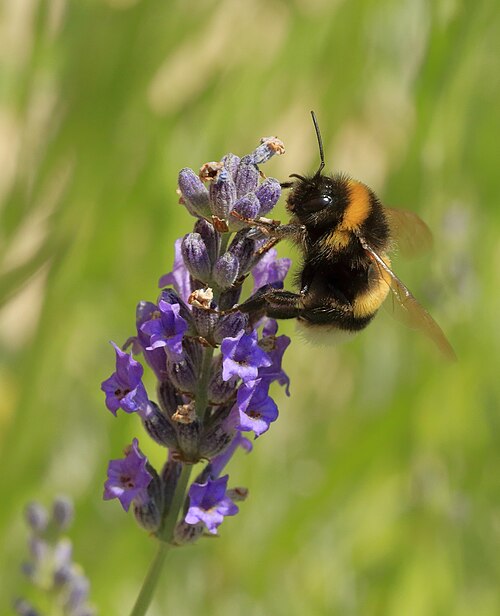
Bumblebee (Bombus terrestris) on lavender blossom. Photo: Martin Falbisoner, CC BY-SA 4.0.
Overview
Bumblebees are among the most recognizable and beloved of all insects — large, densely furred, characteristically buzzing as they move between flowers. But beyond their familiar appearance lies a biology of remarkable sophistication. Bumblebees are the world's most effective practitioners of buzz pollination, the only bees capable of the vibrational technique that unlocks pollen from tomatoes, blueberries, cranberries, and dozens of other crops. They are also among the most cold-tolerant insects on Earth — some species are active above the Arctic Circle — and among those facing the most severe documented population declines of any bee group.
The approximately 250 known species of Bombus are found throughout the Northern Hemisphere, with the greatest diversity in temperate montane regions. South America has a separate radiation of bumblebee species descended from a single colonization event from North America. Bumblebees are entirely absent from sub-Saharan Africa, Australia, and most of Southeast Asia.
Physical Description
Bumblebees are immediately recognizable by their large, robust bodies and dense covering of branched hairs — the "fuzziness" that distinguishes them from most other bees. Body length ranges from approximately 8mm in small worker bumblebees of some species to 25mm in queen bumblebees of larger species. The coloration is typically some combination of yellow, orange, red, white, and black banding, though the exact pattern varies dramatically across species and serves as important identification information. Some species have evolved similar color patterns despite not being closely related — a phenomenon of mimicry that reflects shared predator pressure.
Queen bumblebees are significantly larger than workers — the most pronounced size difference of any common bee genus. A queen Bombus terrestris (the buff-tailed bumblebee) may be two or three times the mass of her workers. Drones are intermediate in size and distinguished by their longer antennae and, in many species, facial coloration that differs from workers. Unlike honeybee drones, male bumblebees are not expelled from the colony — they leave voluntarily in late summer to find mating opportunities.
Buzz Pollination: The Technique That Sets Bumblebees Apart
Buzz pollination — technically called sonication — is the ability to vibrate flight muscles at a specific frequency while gripping a flower's anthers, causing pollen to be explosively released from anther pores that would not open under simple contact. The Western honeybee cannot perform buzz pollination. Bumblebees are among its most effective practitioners.
When a bumblebee encounters a flower requiring buzz pollination — a tomato, pepper, eggplant, or blueberry — she grips the anther cluster with her mandibles and legs, disengages her wings, and contracts her flight muscles rapidly. The resulting vibration, at approximately 400 Hz (close to the musical note G above middle C), resonates through the anther structure and ejects pollen in a visible cloud. The bee is dusted with pollen, some of which is groomed into her pollen baskets and some of which remains on her body to contact the stigma of the next flower she visits.
The commercial importance of buzz pollination is substantial. Greenhouse tomato production — a global industry — historically required either hand pollination using vibrating wands or the introduction of commercial bumblebee colonies. The latter is now standard practice: commercial bumblebee colonies (primarily Bombus terrestris in Europe and Bombus impatiens in North America) are produced by specialist suppliers and sold to greenhouse operators worldwide. The global commercial bumblebee industry is valued at hundreds of millions of dollars annually and exists entirely because of the buzz pollination capability that honeybees lack.
Colony Life
Bumblebee colonies are annual — they are founded in spring by a single mated queen, grow through summer, produce new queens and males in late summer, and die entirely by autumn. Only newly mated queens survive winter, hibernating in the soil, under bark, or in other sheltered spots until spring temperatures trigger their emergence.
A founding queen emerges from hibernation — often when ground temperatures are barely above freezing — and must immediately find sufficient food to fuel her search for a nest site. This early-spring period is the most dangerous in a queen's life and the period for which the planting of early-flowering plants (crocus, pussy willow, early fruit blossom) has the greatest conservation impact. A queen that cannot find food in her first days after emergence will die, and with her, the colony that would have developed.
Once a nest site is found — typically a pre-existing cavity such as an abandoned rodent burrow or grass tussock — the queen constructs the first wax cells, lays her first eggs, and begins incubating them by shivering her flight muscles to maintain warmth. The first workers emerge approximately four weeks after colony founding and immediately begin foraging, rapidly accelerating colony growth. By midsummer, a healthy colony may contain 200 to 500 workers and begin producing the new queens and drones that will carry the colony's genes into the next season.
Cold Tolerance and High-Altitude Adaptation
Bumblebees are unique among bees in their ability to remain active at low temperatures. While honeybees typically cease foraging below 10°C (50°F), some bumblebee species forage at temperatures near freezing. The Arctic bumblebee (Bombus polaris) is active above the Arctic Circle and has been recorded at elevations above 5,000 meters in the Himalayas. This cold tolerance arises from bumblebees' ability to generate substantial metabolic heat by shivering their flight muscles — the same mechanism used by queens to incubate their eggs — and from the insulating properties of their dense hair covering.
This cold tolerance makes bumblebees disproportionately important in alpine and Arctic ecosystems, where they are often the only effective pollinators of the flowering plants that bloom briefly in short growing seasons. The loss of bumblebee species from high-elevation habitats — documented in multiple mountain ranges as climate change alters the distribution of suitable temperatures — has cascading effects on the plant communities that depend on them.
Conservation Status: A Crisis in Progress
Bumblebees are among the most threatened bee groups in the world, and their decline is among the best-documented of any invertebrate group. In North America, a landmark 2011 study found that four previously common species had declined by 96% or more and contracted their ranges by 87% in the preceding two decades. In Europe, several species are now extinct or functionally extinct across most of their former range.
The primary drivers of bumblebee decline are habitat loss (the reduction of flower-rich grasslands and heathlands), pesticide exposure (particularly fungicides, which impair immune function, and neonicotinoids), and the spread of pathogens from commercial bumblebee operations into wild populations. Climate change compounds these pressures: bumblebee ranges are contracting at their warm southern margins without expanding proportionally at northern and upper-elevation margins, producing a net loss of viable habitat.
The rusty patched bumblebee (Bombus affinis) became the first wild bee in the continental United States to be listed as Endangered under the Endangered Species Act, in 2017. Its population had declined by approximately 87% since the late 1990s. The Franklin's bumblebee (Bombus franklini), endemic to a small area of southern Oregon and northern California, has not been confirmed alive since 2006 and may already be extinct.
A bumblebee queen incubating her first eggs maintains the brood cluster at approximately 30°C regardless of external temperature — she has been observed incubating in ambient temperatures below 0°C, shivering continuously to maintain warmth. This active thermoregulation of the brood is a trait shared with honeybees and is one of the distinguishing features of advanced social insects.