Kingdom: Animalia
Order: Hymenoptera
Family: Megachilidae
Genus: Osmia
Species: ~350 known
Size: 8–16mm
Social structure: Solitary
Nesting: Hollow stems, rock crevices, mud-sealed cavities
Active season: Early spring through early summer
Range: Northern Hemisphere
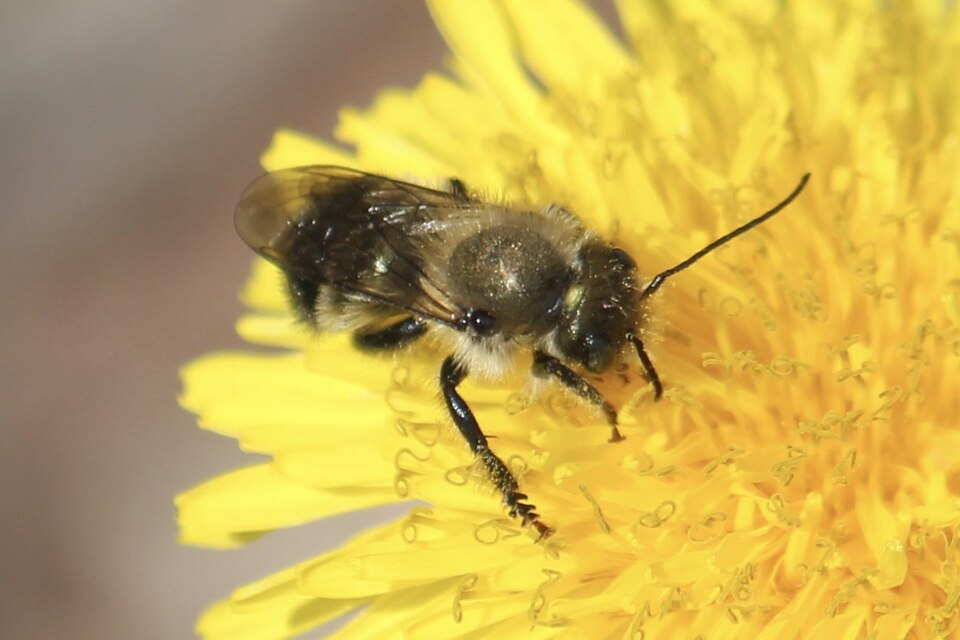
Red mason bee (Osmia bicornis). Photo: S. Rae / Flickr, CC BY 2.0.
Overview
Mason bees are among the most important and least appreciated pollinators in the world. While the honeybee receives the majority of public and commercial attention, the approximately 350 species of mason bee (genus Osmia) surpass the honeybee in pollination efficiency for virtually every fruit tree crop tested. An orchard planted with an adequate population of blue orchard mason bees (Osmia lignaria) can be fully pollinated with a fraction of the honeybee colonies that would otherwise be required.
The common name "mason bee" comes from the females' habit of sealing their nest cells with mud — like a mason working with mortar. Unlike the honeybee, mason bees are entirely solitary: each female builds and provisions her own nest without assistance, and individuals do not cooperate or share resources in any way. Despite this solitary life, mason bees are often found in aggregations where suitable nesting habitat is concentrated — dozens or hundreds of individual nests in close proximity in a favorable site.
Why Mason Bees Are Such Effective Pollinators
Mason bees outperform honeybees at orchard pollination for several interconnected reasons. First, they carry pollen dry on specialized hairs on their abdomen (scopa) rather than in wet pollen baskets — pollen that is not packed with nectar is more likely to be transferred to receptive stigmas rather than retained by the bee. A foraging mason bee is essentially a walking pollen brush, depositing pollen on every flower she contacts. Second, mason bees are significantly more willing than honeybees to forage in cool, cloudy, and windy conditions — the spring weather typical during apple, cherry, and pear blossom. Third, mason bees are more likely to remain within a specific orchard rather than ranging far afield: they tend to forage in the immediate vicinity of their nest, concentrating their activity in the target crop.
Research at Oregon State University and other institutions has established that approximately 250 to 300 female blue orchard mason bees per acre can provide adequate pollination for commercial apple production — an area that would require 1.5 to 2 honeybee colonies per acre under conventional management. This pollination efficiency makes mason bees of significant and growing commercial interest, particularly as honeybee colony availability tightens and rental costs rise.
Nesting Biology
Mason bees are cavity nesters — they do not excavate their own nesting sites but occupy pre-existing tunnels in wood, hollow plant stems, holes in stone or masonry, or any suitable narrow cavity with an entrance diameter of 6 to 10mm. A female inspects a potential cavity before accepting it, typically preferring south-facing sites with good solar exposure that warm quickly in the morning.
Once a cavity is accepted, the female begins provisioning. She makes repeated foraging trips, collecting nectar and pollen that she packs into a compact mass at the back of the cavity — sufficient food to support larval development through to pupation. She then lays a single egg on the pollen mass, seals the cell with a thin wall of mud, and begins provisioning the next cell. A single nest cavity may contain 5 to 10 cells arranged in a linear series, each sealed individually. The female lays unfertilized (male) eggs at the outer end of the nest and fertilized (female) eggs at the deeper, better-protected inner end — a strategic allocation that ensures females have a higher probability of surviving to reproduce despite the greater mortality risk at the outer nest positions.
After completing a nest, the female moves to another cavity and begins again. A productive female may complete 3 to 5 nests containing 15 to 40 eggs during her 4 to 6 week adult life. She seals the final entrance of each completed nest with a thick mud plug before leaving or after the final cell is provisioned.
Life Cycle
Mason bee eggs hatch within a few days. The larvae feed on the pollen and nectar provisions, grow rapidly, and pupate within their sealed cells in summer. The adult bee develops fully inside the pupal case and remains inside the sealed cell through autumn and winter, emerging only when spring temperatures warm sufficiently — typically when consistent daytime temperatures exceed 10–12°C (50–54°F).
The timing of emergence is closely synchronized with the bloom of target flower species in many mason bee species — a co-evolutionary relationship refined over millions of years. Blue orchard mason bees typically emerge during or just before the bloom of apple, cherry, and other early-season fruit trees in temperate North America. This synchrony makes them particularly valuable for spring orchard pollination but also makes them potentially vulnerable to phenological mismatch if climate change causes flower bloom and bee emergence to decouple.
Supporting Mason Bees in Your Garden
Mason bees are among the easiest native bees to support and attract, requiring only three things: flowers for food, nesting cavities, and a source of mud for cell construction. A bee house — a bundle of hollow bamboo tubes, drilled wooden blocks, or purpose-built cavity structures — placed in a south-facing, sheltered location at 1 to 1.5 meters height will typically be colonized by local Osmia species within a season in areas where they are present.
Cavity diameter is important: blue orchard mason bees prefer cavities of 6 to 8mm diameter; smaller species prefer 4 to 6mm. Depth of at least 15cm is recommended to allow the female to lay the preferred number of cells. Cavities must be closed at the back end — open-ended tubes are not used. Bamboo tubes or paper tube inserts are preferred over drilled wood because they allow the cocoons to be removed for cleaning and monitoring, which reduces pathogen buildup and improves population health over time.
A small patch of bare, moist soil near the bee house provides nesting material. Native wildflowers — particularly those blooming in early spring when mason bees are most active — provide essential forage.
Female mason bees collect mud from puddles, pond margins, or wet soil in their mandibles and carry it to the nest, where they pack it into precise cell partitions and entrance plugs. A single female may make 20 or more mud-collecting trips per nest cell. The mud dries to a hard, cement-like material that protects the developing bee through winter. Some Osmia species use plant resins, chewed leaves, or sand mixed with secretions rather than mud — earning the alternative names "resin bees" or "pebble bees" for some species.