Kingdom: Animalia
Order: Hymenoptera
Family: Megachilidae
Genus: Megachile
Species: ~1,500 known
Size: 7–20mm
Social structure: Solitary
Nesting: Cavities lined with leaf discs
Pollen carry: Abdominal scopa (unique)
Range: Worldwide except polar regions
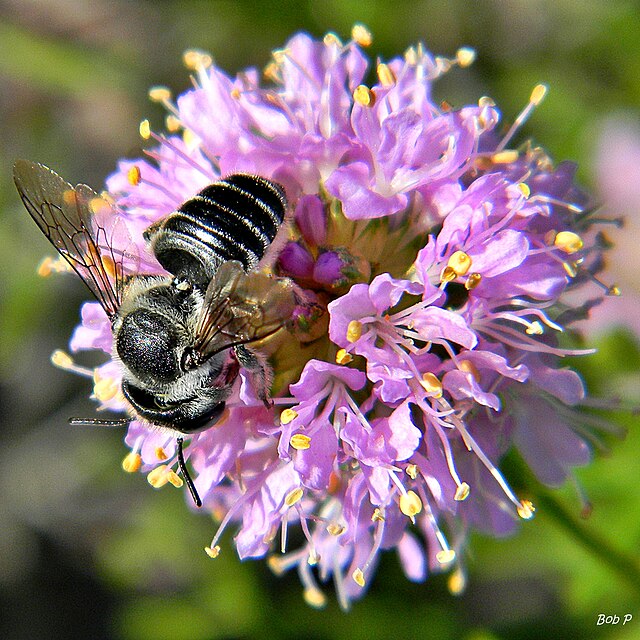
Leafcutter bee (Megachile campanulae). Photo: USGS Bee Inventory and Monitoring Lab, Public Domain.
Overview
Leafcutter bees are remarkable in multiple respects. They are the largest genus of bees in the world — approximately 1,500 described species, with more awaiting formal description. They display one of the most distinctive and immediately recognizable behaviors of any insect: the precise cutting of circular and oval discs from plant leaves, carried in flight back to the nest to construct elaborate brood cells. And one species — the alfalfa leafcutter bee (Megachile rotundata) — is commercially managed on a large scale for the pollination of alfalfa seed crops, making it one of only a small number of non-honeybee species with a significant managed role in commercial agriculture.
The genus Megachile is found on every continent except Antarctica and shows extraordinary diversity in size, behavior, and specialization. The smallest species are under 7mm; the largest, including the Wallace's Giant Bee (Megachile pluto) of Indonesia — the world's largest known bee — reach 38mm in body length. Most species are intermediate in size, broadly resembling stocky, somewhat flattened honeybees, distinguished by the conspicuous scopa of pollen-collecting hairs on the underside of the abdomen.
The Leaf-Cutting Behavior
The behavior that gives leafcutter bees their name is as precise as it is distinctive. A foraging female identifies a suitable leaf — typically from rose, lilac, Virginia creeper, or various other broad-leaved plants — lands on the leaf surface, and uses her mandibles to cut a circular or oval disc in a single continuous motion taking 5 to 10 seconds. She then grasps the disc with her legs and mandibles and flies directly to her nest, holding the disc beneath her body.
The disc is used to construct a thimble-shaped cell within the nest cavity. The female begins with a series of oval "wrapper" leaves that form the cell walls, then adds circular "cap" leaves that form the cell bottom and eventually the cell top. The finished cell — a perfectly proportioned cylinder of overlapping leaf sections — is packed with a mixture of pollen and nectar (bee bread), an egg is laid on the provisions, and the cell is sealed with additional leaf discs. The construction of a single cell requires 8 to 15 leaf disc trips and takes approximately an hour.
The leaf cutting is precise: cells cut from the same leaf or the same type of leaf are remarkably consistent in size and shape, suggesting the bee has an internal template for the required dimensions. The botanical identity of the leaf used seems to matter relatively little to most species — the structural and moisture-retaining properties of the leaf material are what matter.
Pollen Carrying: The Abdomen as a Pollen Basket
Most bees carry pollen in specialized structures on their hind legs. Leafcutter bees (and other members of the family Megachilidae) carry pollen on a dense brush of hairs — the scopa — on the ventral surface of the abdomen. This difference has a significant consequence for pollination efficiency: pollen carried on the abdomen is held more loosely and is more easily transferred to flower stigmas than pollen packed into leg corbicula. A foraging leafcutter bee, with her pollen-dusted abdomen, deposits pollen on the stigma with every contact — making her a particularly effective cross-pollinator.
The abdominal scopa is visible in the field as a bright yellow, orange, or white brush on the underside of the bee's abdomen. A heavily loaded foraging female carries so much pollen that the scopa appears to glow. This field mark — combined with the leaf-cutting behavior and the characteristic stocky build — makes leafcutter bees relatively easy to identify at the genus level without close examination.
The Alfalfa Leafcutter Bee and Commercial Agriculture
The alfalfa leafcutter bee (Megachile rotundata) is native to Europe and Central Asia but was introduced to North America in the mid-20th century, where it has become indispensable to alfalfa seed production. Alfalfa (Medicago sativa) is the most important forage crop in North America — the primary food source for dairy cattle and a major component of feed for beef cattle, horses, and other livestock. Alfalfa seed production requires insect pollination because the flower's reproductive organs are enclosed within the flower petals (a mechanism called "tripping") and must be mechanically released by an insect visitor.
Honeybees visit alfalfa flowers but are reluctant to "trip" them because the mechanical release hits the bee in the face — an unpleasant experience the honeybee learns to avoid by accessing nectar from the side without tripping the flower. The alfalfa leafcutter bee, by contrast, trips alfalfa flowers readily and consistently, making it a far more effective alfalfa pollinator than the honeybee.
Commercial alfalfa seed production in the western United States and Canada now relies almost entirely on the alfalfa leafcutter bee. Growers purchase cocoons from specialist suppliers — typically tens of thousands to hundreds of thousands per field — and incubate them in shelters at the field margin timed to coincide with alfalfa bloom. The commercial alfalfa leafcutter bee industry produces and ships billions of cocoons annually and supports a multi-million dollar specialized beekeeping sector distinct from honeybee management.
Wallace's Giant Bee
The most famous member of the genus Megachile is unquestionably Megachile pluto — Wallace's Giant Bee, the world's largest known bee. Described by Alfred Russel Wallace during his Malay Archipelago expedition in 1858 and not encountered alive again until 1981, it was rediscovered in Indonesian forests in 2019 by a team of naturalists searching specifically for it — the first time it had ever been photographed alive. Females reach 38mm in body length with a wingspan of 63mm. Unlike most leafcutter bees, Wallace's Giant Bee does not use leaf material in its nest construction — it builds its nest inside the mounds of arboreal termites, lining its brood cells with plant resin collected from surrounding trees.
Leafcutter bees cut leaf discs with remarkable consistency — cells cut for the cylindrical outer wall of a brood cell are oval, while cells cut for the end caps are circular, and the diameters are precisely matched to the nest cavity diameter. This dimensional precision, produced by an insect with a brain of approximately 1 million neurons, operating without measurement tools or blueprints, is a striking example of the behavioral sophistication of social and solitary bees.