Kingdom: Animalia
Order: Hymenoptera
Family: Apidae
Genus: Apis
Species: A. mellifera
Size: Worker 15mm, Queen 20mm, Drone 17mm
Weight: Worker ~0.1g
Colony size: 20,000–80,000
Lifespan: Worker 6 weeks (summer); Queen 3–5 years
Native range: Africa, Europe, Middle East
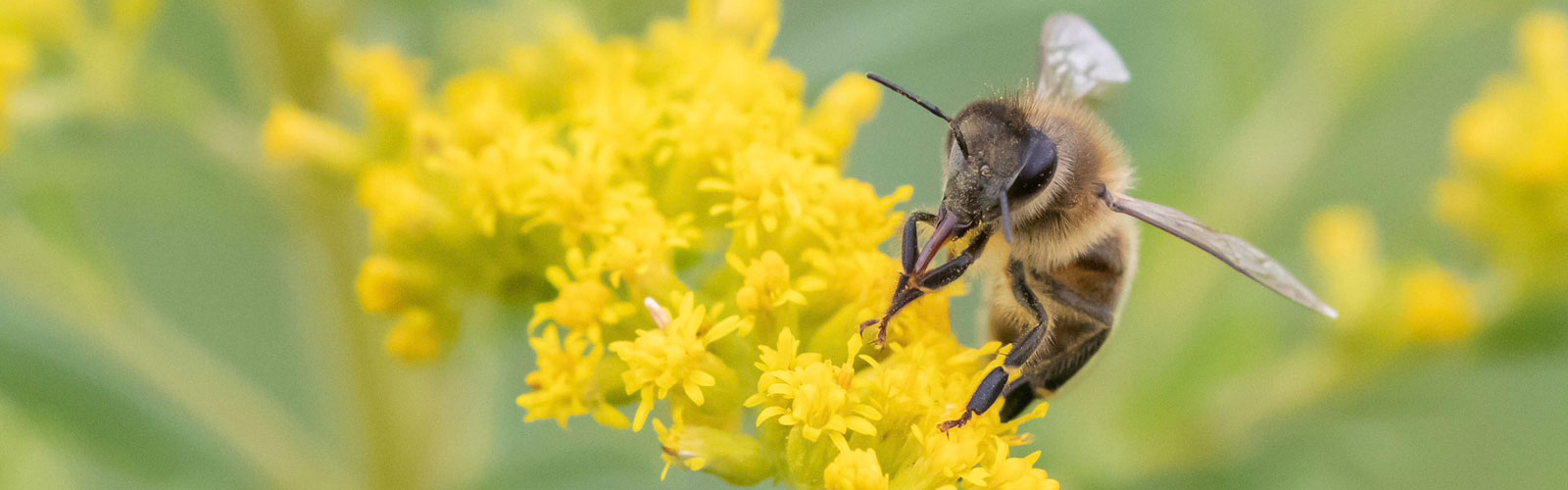
Western honeybee (Apis mellifera) on lavender. Photo: Luc Viatour, CC BY-SA 2.5.
Overview
The Western honeybee is the most studied animal on Earth after humans and laboratory mice, and with good reason. Apis mellifera is the primary managed pollinator of agricultural crops globally, the only bee that produces honey at commercial scale, and a model organism for research into social behavior, collective intelligence, neuroscience, and evolution. Its importance to human civilization is difficult to overstate: without the Western honeybee, the global food system would face an immediate and catastrophic pollination deficit.
Despite its global ubiquity — introduced to the Americas, Australia, and parts of Asia by European settlers, the Western honeybee is now found on every inhabited continent — it is native only to Africa, Europe, and the western regions of Asia. Its extraordinary adaptability across climates, from tropical Africa to Arctic Scandinavia, reflects both the range of subspecies that have evolved in different environments and the species' fundamental flexibility as a social organism capable of regulating its own environment through collective thermoregulation, ventilation, and food storage.
Physical Description
Worker honeybees are approximately 15mm in length, with a characteristic amber-to-brown coloration banded with darker brown or black. The abdomen is distinctly banded; the exact pattern and coloration varies among the more than 30 recognized subspecies of Apis mellifera. Workers are densely covered in branched body hairs that serve to collect pollen electrostatically during flower visits. The hind legs bear the specialized pollen baskets (corbiculae) — concave, hair-fringed structures visible as orange or yellow masses on foraging workers returning to the hive.
Queens are noticeably larger than workers — approximately 20mm in length — with a longer, more tapered abdomen. Their wings are proportionally shorter relative to body length than workers', and they lack pollen baskets. Drones are similar in length to queens but broader and more robust, with enormous compound eyes that meet at the top of the head — an adaptation for spotting and pursuing virgin queens during mating flights.
Distribution and Subspecies
The Western honeybee's native range spans sub-Saharan Africa, Europe, and the Middle East. More than 30 subspecies are recognized, each adapted to local climatic conditions and flower communities. Among the most significant are: A. m. ligustica (the Italian honeybee), the most widely kept subspecies in commercial beekeeping globally, known for its gentle temperament, high honey production, and large colony size; A. m. carnica (the Carniolan honeybee), native to Slovenia and Austria, prized for its winter hardiness and rapid spring buildup; and A. m. scutellata (the African honeybee), the parent species of the Africanized honeybee — introduced to South America in the 1950s and now naturalized throughout tropical and subtropical Americas.
Colony Structure and Social Organization
A Western honeybee colony at peak summer strength contains 50,000 to 80,000 individuals organized into three castes: one queen, thousands of female workers, and hundreds to a few thousand male drones. The colony functions as a superorganism — a single integrated biological entity whose collective behaviors and homeostatic capacities exceed anything any individual member could achieve alone.
The queen is the colony's sole reproductive female. She produces all fertilized eggs (which become workers or new queens) and unfertilized eggs (which become drones), laying up to 2,000 eggs per day at peak season. She maintains colony cohesion through a complex blend of pheromones — queen mandibular pheromone (QMP) — that suppresses worker reproduction, attracts workers, and triggers a cascade of colony-level responses that keep the colony functioning as a unit.
Workers progress through a predictable sequence of tasks as they age — cell cleaning, nursing, wax production, food processing, guarding, and finally foraging — a system called temporal polyethism that ensures the colony's diverse labor needs are met by workers at the appropriate physiological stage. A worker bee lives approximately six weeks in summer, during which time she may visit several thousand flowers per day and fly a cumulative distance of several hundred miles.
Communication: The Waggle Dance
The honeybee's waggle dance is one of the most remarkable phenomena in animal behavior. When a foraging bee returns from a rich food source, she performs a figure-eight dance on the vertical surface of the comb in the dark interior of the hive. The direction of the straight "waggle run" relative to vertical encodes the direction to the food source relative to the sun. The duration of the waggle run encodes the distance. The vigor of the dance encodes the quality of the source.
Attendant bees follow the dancer with their antennae, reading the mechanical signals of direction and duration, and then navigate independently to the food source the dancer described — achieving accuracy of approximately 10% of actual distance and direction, over distances of several kilometers, in a system that operates entirely by touch and vibration in complete darkness. This system, decoded by Karl von Frisch and recognized with the Nobel Prize in 1973, remains the most sophisticated example of symbolic communication demonstrated in any non-human animal.
Honey Production
The Western honeybee is the only bee species that produces honey in sufficient quantities to sustain commercial production. A productive colony in a good forage year produces 60 to 100 pounds of surplus honey above its own winter requirements. To produce one pound of honey, foragers must visit approximately 2 million flowers and fly a cumulative distance of roughly 55,000 miles — the equivalent of more than twice around the Earth.
Honey is not simply concentrated nectar. It is a biochemically transformed product: foragers add enzymes (invertase, glucose oxidase) to nectar during collection and during processing in the hive; house bees evaporate the water content from approximately 80% to below 20% through fanning and repeated regurgitation; and the resulting product contains hydrogen peroxide — generated by glucose oxidase from glucose in nectar — that gives honey its remarkable antimicrobial properties and effectively infinite shelf life.
Agricultural Importance
The Western honeybee is responsible for the pollination of crops worth an estimated $15–20 billion annually in the United States and several hundred billion dollars globally. More than 100 U.S. crops depend on or significantly benefit from honeybee pollination, including almonds (100% dependent), apples, blueberries, cherries, avocados, cucumbers, squash, and hundreds of others. The commercial migratory beekeeping industry — which transports hives by the millions across the country to follow bloom seasons — is an agricultural logistics operation of extraordinary scale that remains largely invisible to consumers.
Threats and Conservation Status
The Western honeybee is not threatened with extinction as a species — its global distribution and domesticated populations ensure its survival. However, managed colony populations in North America and Europe have declined dramatically since the mid-20th century, from approximately 6 million managed colonies in the U.S. in the 1940s to fewer than 2.5 million today. Annual colony loss rates of 30–40% — against a historical norm of 10–15% — represent a sustained crisis for the beekeeping industry and for the agricultural systems that depend on managed pollination.
The primary threats to managed honeybee populations are the Varroa destructor mite (present on every continent except Australia), the suite of viruses Varroa vectors (particularly Deformed Wing Virus), neonicotinoid and other pesticide exposure, nutritional stress from monoculture landscapes, and the full suite of threats discussed in detail in the Threats section of this site.
The Western honeybee has been introduced to every inhabited continent and is now the world's most widespread bee species. In Australia — which has no native social bees — it is both an agricultural essential and an ecological concern, as feral populations compete with native solitary bees for floral resources. In North America, it has been present since European colonization in the 17th century and is now naturalized as well as managed across the continent.