| Quick Facts — Mining Bees (Andrena) | |
|---|---|
| Genus | Andrena (family Andrenidae) |
| Known species | ~1,500 worldwide |
| Distribution | Holarctic region (North America, Europe, Asia, North Africa) |
| Body length | 8–17mm depending on species |
| Social behavior | Solitary; some form dense aggregations |
| Nesting | Ground-nesting; individual burrows in sandy or bare soil |
| Season | Early spring through early summer (most species) |
| Notable feature | Many species are oligolectic — visiting only one plant genus |
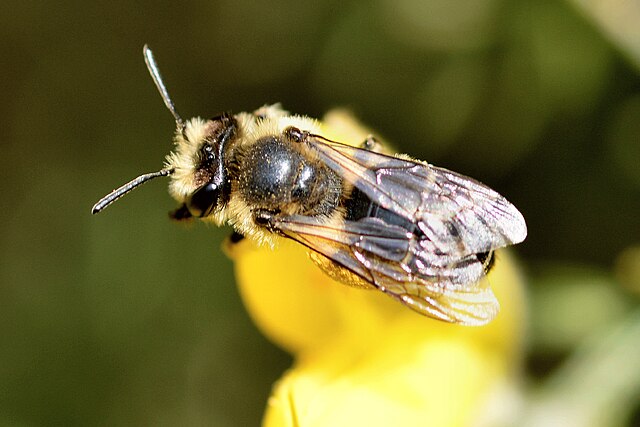
Tawny mining bee (Andrena fulva), female. Photo: Gideon Pisanty, CC BY 3.0.
The Harbingers of Spring
While the world is still cold and the first snowdrops have barely opened, mining bees are already emerging from the ground. Female mining bees of many species can be active at temperatures as low as 7–10°C — far below the flight threshold of the honeybee (approximately 13°C) and most other bee species. This cold tolerance gives them exclusive access to a foraging window when few other pollinators are present, making them indispensable pollinators for early-blooming plants.
In apple, cherry, pear, and plum orchards across Europe and North America, the early mining bee (Andrena fulva) — a fox-red female that is one of the most conspicuous spring insects in temperate gardens — is often the primary pollinator during the critical bloom window, arriving before managed honeybee colonies have built sufficient population to forage effectively.
Master Excavators
Mining bees take their name from their nesting behavior. Each mated female excavates a burrow in the soil — typically 10–60cm deep depending on species — using her mandibles and front legs to loosen soil and her mid and hind legs to carry it to the surface. The excavated soil accumulates around the tunnel entrance as a small mound or volcano, a characteristic sign of mining bee activity that can be found in garden lawns, sandy banks, and bare soil patches from February through June in temperate regions.
At the base of the main tunnel, the female constructs individual brood cells — each a smooth, oval chamber lined with a waterproof secretion from her Dufour's gland. She provisions each cell with a mass of pollen mixed with nectar, lays a single egg on the surface of the pollen mass, seals the cell, and moves on to the next. A single female may construct 6–20 brood cells during her adult life, spending weeks on the exhausting work of excavation, foraging, and provisioning before dying — never seeing her offspring.
Flower Specialists
Many mining bee species are oligolectic — they collect pollen from only a single plant genus or a small group of closely related plants. This specialization, evolved over millions of years of co-evolution between bee and plant, makes these species extraordinarily efficient pollinators of their target plants but also makes them acutely vulnerable to the decline of those plants. The spring beauty miner (Andrena erigeniae) in North America visits exclusively the spring beauty wildflower (Claytonia virginica). The blueberry miner (Andrena bradleyi) specializes on blueberry and related heath family plants. When their host plant declines, these specialists decline with it.
Aggregation Nesting
While mining bees are solitary — each female nests and provisions independently — many species exhibit aggregation nesting: hundreds or thousands of individual females nesting in close proximity in the same patch of suitable habitat. A sunny south-facing bank of bare sandy soil may host a dense aggregation with hundreds of nest entrances per square meter. These aggregations are not colonies — the females do not cooperate — but the sight of dozens of bees flying in and out of a patch of ground is dramatic enough that they are sometimes mistakenly reported as a wasp nest. Mining bee aggregations are harmless and should be celebrated as a sign of healthy native bee habitat.