| Quick Facts — Wallace's Giant Bee | |
|---|---|
| Scientific name | Megachile pluto Wallace, 1858 |
| Family | Megachilidae |
| Body length | Female: 38mm — the largest known bee species |
| Wingspan | Up to 63mm |
| Native range | North Maluku islands, Indonesia (Bacan, Halmahera, Tidore, Makian) |
| Habitat | Lowland tropical rainforest |
| Nesting | Inside active arboreal termite mounds; lines cells with plant resin |
| First described | Alfred Russel Wallace, 1858 |
| Rediscovered alive | January 2019 — first live photographs ever taken |
| Conservation status | Vulnerable (IUCN); primary threats are deforestation and specimen collection |
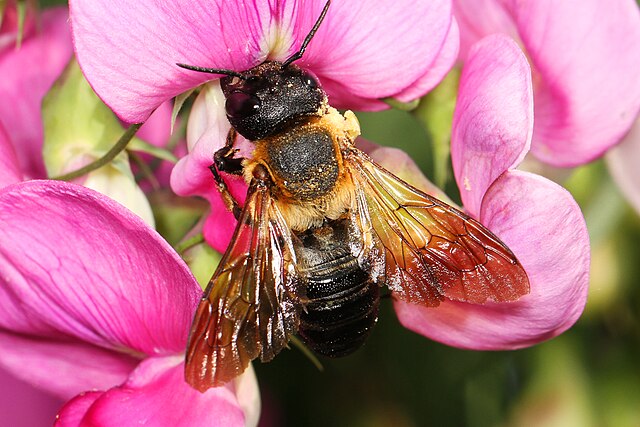
Wallace's giant bee (Megachile pluto), male specimen. Photo: Simon Robson, CC BY-SA 4.0.
Discovery: A Bee Like a Bulldog
Alfred Russel Wallace — the naturalist who independently developed the theory of evolution by natural selection alongside Charles Darwin — collected the first known specimen of Megachile pluto on the island of Bacan in the North Moluccas (now North Maluku province, Indonesia) in 1858. His notes described a large, black "Wallace's bee" with enormous mandibles, but the species received little scientific attention and disappeared from the scientific record almost entirely for over a century.
In 1981, the entomologist Adam Catton Messer rediscovered the bee on three Indonesian islands and documented its extraordinary nesting behavior — the first scientific observation of a living individual. Then the bee vanished again from scientific awareness for nearly four decades, known only from a handful of dried museum specimens and Messer's brief field notes.
Rediscovered in 2019
In January 2019, a team of researchers and wildlife photographers led by Simon Robson of the University of Sydney and clay specialist Eli Wyman of Princeton University located a living female Wallace's Giant Bee in a fragment of lowland forest on a North Maluku island. The photographs they took — the first ever of a living individual of the species — were published in February 2019 and became an immediate global news story, combining the extraordinary size of the animal, the drama of the rediscovery, and the conservation urgency of its situation.
The female they found was exactly as extraordinary as Wallace's notes had suggested: 38mm long, with mandibles larger than those of most stag beetles, carrying a ball of tree resin she was using to line a brood cell inside an arboreal termite mound. The scientific team chose not to collect the specimen, leaving her alive — a decision that reflected the conservation sensitivity of a species so rare that removing a single individual could have measurable population consequences.
Biology and Nesting
What makes Wallace's Giant Bee biologically remarkable is not just its size but its nesting strategy. It is the only known bee that nests exclusively inside the mounds of arboreal termites — the large, enclosed paper nests that tree-dwelling termite species construct on branches and trunks of tropical forest trees. The bee uses her enormous mandibles — which are why she is so much larger than other Megachile — to scrape plant resin from local trees and carry large balls of it back to her nest. She then uses this resin to line the interior of brood cells she has excavated within the termite mound, creating smooth, antiseptic chambers that protect her larvae from the termite colony surrounding them.
Why termite mounds? The termites maintain a remarkably stable internal environment — constant temperature and humidity — that is ideal for bee larval development. The termites appear to tolerate the bee's presence, perhaps because the resin she introduces has antimicrobial properties that benefit the termite colony as well as her own larvae.
Conservation Status and Threats
Wallace's Giant Bee faces two primary threats: habitat loss and specimen collection. The lowland tropical forests of North Maluku have been subjected to significant logging, conversion to agriculture, and development pressure. The arboreal termite mounds that the bee depends on for nesting are found only in mature forest — they cannot be replicated in degraded or secondary habitats.
Specimen collection by private collectors represents an acute threat to a species of such extreme rarity. Following the publication of the 2019 photographs, multiple Wallace's Giant Bee specimens appeared for sale on online auction platforms at prices reaching $9,000 USD — a price point that creates strong economic incentive for collection from wild populations. Conservation organizations immediately called for trade controls under CITES (the Convention on International Trade in Endangered Species) and for strengthened protection within Indonesia.
The total wild population of Wallace's Giant Bee is completely unknown. Given the limited range, habitat specificity, and the fact that it was "lost" to science for 38 years twice, the population is almost certainly very small. It represents one of the most compelling arguments for the urgency of tropical forest conservation — an animal of extraordinary biological interest, found nowhere else on Earth, dependent on a rapidly disappearing habitat.