| Quick Facts — Digger Bees (Anthophora) | |
|---|---|
| Genus | Anthophora (family Apidae, tribe Anthophorini) |
| Known species | ~1,000 worldwide |
| Distribution | Worldwide except Australia and Antarctica |
| Body length | 10–20mm depending on species |
| Social behavior | Solitary; some form dense aggregations |
| Nesting | Ground-nesting in earthen burrows; some nest in soft mortar or clay banks |
| Flight speed | Among the fastest of any bee — sustained flight up to 25 mph |
| Season | Early spring through summer depending on species |
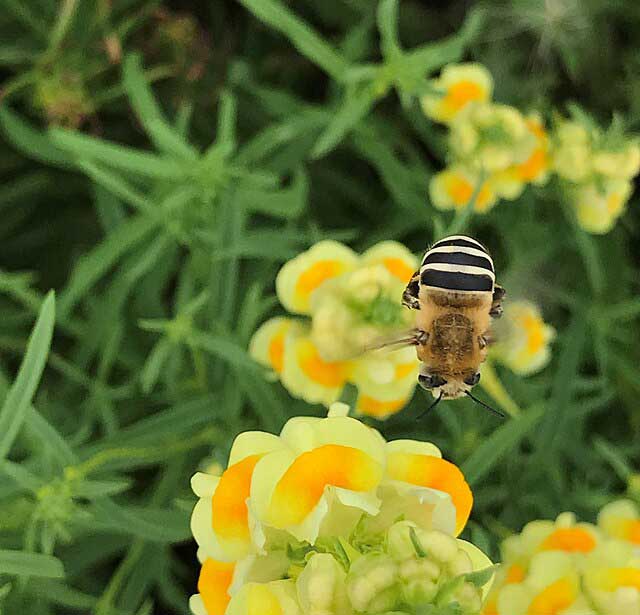
Hairy-footed flower bee (Anthophora plumipes), female. Photo: S. Rae / Flickr, CC BY 2.0.
Built for Speed
Digger bees — members of the large and diverse genus Anthophora — are among the fastest flying of all bees, capable of sustained flight at speeds up to 25 miles per hour. Their robust, densely furred bodies give them a superficial resemblance to small bumblebees, but their flight is entirely different in character: where bumblebees lumber with a deliberate buzz, digger bees dart and hover with a speed and precision that can make them difficult to track with the naked eye.
This flight capability is not merely impressive — it is ecologically significant. Digger bees can cover large foraging distances quickly, visiting many individual flowers per unit time. Combined with their dense body hair — which carries large pollen loads — this makes them highly efficient pollinators per individual bee, even though they lack the numerical advantage of social species.
Ground Nesters and Cliff Dwellers
Like mining bees, digger bees nest in the ground, excavating burrows in a variety of soil types. Unlike the preference of many mining bees for sandy, well-drained soil, several Anthophora species nest in clay or compacted earth, and some nest in the soft mortar of old brick walls or in earthen cliff faces — giving rise to the name "chimney bee" for certain species that build distinctive chimney-like turrets of soil around their burrow entrances.
The plasterer bee Anthophora plumipes — one of the most commonly encountered digger bees in European gardens, active from March through May — frequently nests in the soft mortar of old stone walls and in earth banks. Its dense, ginger-furred females and black-and-yellow males are often seen hovering in rapid, weaving patterns around nesting aggregations, the males pursuing females in energetic mating chases.
Diverse Foraging Strategies
The ~1,000 species of Anthophora show considerable diversity in their foraging preferences. Some species are polylectic generalists, visiting a wide range of flowering plants. Others are oligolectic specialists tied to specific plant families — particularly the borage family (Boraginaceae), the mint family (Lamiaceae), and various legumes. In arid and semi-arid landscapes of the American Southwest, Mediterranean basin, and Central Asia, where Anthophora diversity is particularly high, digger bees are among the most important pollinators of desert wildflowers and spring ephemerals.
Several Anthophora species have evolved extremely long tongues to access nectar from deep-tubed flowers — a parallel adaptation to that seen in some orchid bees. The long-tongued digger bee Anthophora bomboides specializes on lupines and other long-tubed flowers that short-tongued generalists cannot efficiently exploit.
Importance in Early Spring
Many Anthophora species are among the earliest bees active in spring in temperate regions, emerging weeks before managed honeybee colonies have built sufficient population to forage effectively. In Mediterranean climates — where spring arrives early and the bee season is longer — digger bees are active through much of the year and play a primary role in the pollination of early spring wildflowers and orchard crops. In the United Kingdom, Anthophora plumipes is frequently active in March, providing vital early pollination services to lungwort, comfrey, and early fruit blossoms.
Cleptoparasites: Melecta and Relatives
Several bee genera are cleptoparasites — "cuckoo bees" — that specialize in parasitizing Anthophora nests. Melecta species in Europe and North America are the most studied: black and white spotted bees that lurk near Anthophora nesting aggregations, waiting for females to leave their burrows before entering to lay their own eggs on the host's pollen provisions. The Melecta larva hatches first and consumes the pollen intended for the Anthophora larva. This parasitic relationship has co-evolved over millions of years alongside the host bee, and the presence of Melecta in a habitat is itself an indicator of healthy Anthophora populations.